
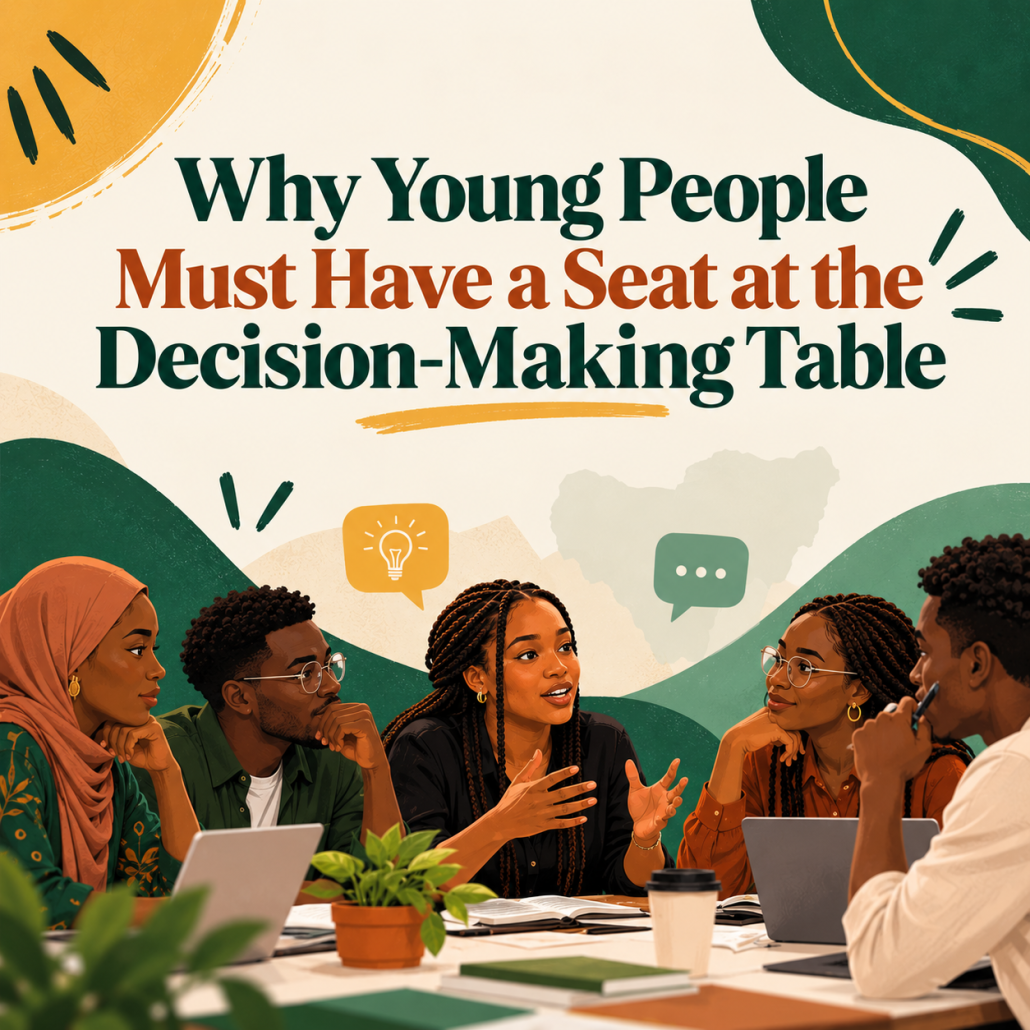
For many years, there has been an assumption that important decisions should primarily be left to older generations because age is often associated with experience, authority, and wisdom. These key features are valuable, but should not be the only factor determining whose voice is heard. In Nigeria, young people are not waiting for permission to contribute to society. They are creating businesses, developing innovations, organising communities, leading advocacy campaigns, using digital platforms to drive conversations, and challenging systems that affect their everyday lives.
Yet, the people who are most affected by many of these decisions are often not sufficiently involved in making them.
Young people must have a seat at the decision-making table, not simply because they are the next generation, but because they are already stakeholders in the decisions being made today.
Young People Are Already Shaping Nigeria
Young Nigerians are major creators, users and evaluators of the systems and innovations around them. They are often among the first to adopt new technologies, identify problems within existing systems, and develop alternative ways of doing things.
From technology and entrepreneurship to creative industries, community organising, advocacy, and social innovation, young people continue to demonstrate their ability to identify challenges and create responses to them.
The same people who are trusted to build solutions should also be able to contribute to conversations about the policies, structures, and systems within which those solutions operate.
Across Nigeria, there are already young people turning this potential into action. Their work spans gender equality, education, governance, sexual and reproductive health, advocacy, and community development, showing that youth leadership is not simply an idea for the future; it is already happening.
Adebukola “Bukky” Shonibare, founder of Invictus Africa, uses research, data and advocacy to address human rights and gender inequality, including work focused on gender-responsive education budgeting. Borisade Ayobami Bisola, founder of The Girls Pride Initiative for Sustainable Development, has created a youth-led platform addressing girls’ education, teenage pregnancy, gender-based violence and leadership. Nicholason Ugwuanyi, through Nicholasmotivates Initiative and DearMen, engages young people, including boys and young men, in conversations around gender equality and menstrual health. Rotimi Olawale, through YouthHubAfrica, has built platforms that support young Nigerians to engage with governance, education, policy and civic participation.
Their work may take different forms, but it points to the same reality: young Nigerians are already identifying problems, building solutions and contributing to conversations that shape society.
This is particularly important because policies are not abstract ideas. They influence whether someone can access healthcare, obtain accurate information, find employment, receive an education, or participate fully in society.
When young people are excluded from these conversations, decision-makers risk developing policies based on assumptions about young people’s lives rather than their lived realities.
Young People Know Where Systems Fall Short
This is especially important in healthcare.
A policy may state that a service is available to young people, but availability on paper does not always translate into accessibility in practice.
A young person seeking sexual and reproductive healthcare may be concerned about confidentiality. They may fear judgement from a healthcare provider, struggle with the cost of services, lack accurate information, or encounter an environment that does not make them feel respected or safe.
These experiences can reveal gaps that may not be obvious from policy documents or statistics.
This is why young people’s participation in sexual and reproductive health and rights conversations matters. They can help institutions understand not only what barriers exist, but also how those barriers are experienced and what changes could make services more responsive.
At EVA Nigeria, this connection between participation, health, rights, and lived experience is particularly important. If programmes are designed to improve young people’s access to information and services, young people should have opportunities to help shape those programmes.
Youth-Led Advocacy Has Already Shown What Is Possible
Across Nigeria, young people have repeatedly used their voices to bring issues into public conversations and demand greater attention to them.
Some examples include:
These examples matter because they challenge the idea that young people are simply recipients of development. They demonstrate that young people already have the capacity to identify problems, mobilise others, generate ideas, and advocate for change.
The question is therefore not whether young people are capable of contributing.
The question is whether existing decision-making structures are prepared to listen to them and allow their contributions to influence outcomes.
Seat at the Table Must Come With a Voice
There is an important difference between inviting young people into a room and giving them a meaningful role in what happens in that room.
A young person can attend a consultation without their recommendations influencing the outcome. They can speak at a conference while having no role in the decisions that follow. They can appear in an advocacy campaign without being involved in developing its message.
That is participation without power.
“Meaningful youth participation must go beyond consultation. Young people must be part of the creation, decision- making and ownership of the solutions that affect them”
—Buya Nabie Bangura
NextGen@SWAG Fellow, Sierra Leone
Young people should be involved early enough to contribute when problems are being identified, priorities are being established, solutions are being developed, and programmes are being evaluated.
They should be able to ask difficult questions, challenge assumptions, offer alternative perspectives, and receive feedback about what happened to their recommendations.
If young people are repeatedly asked to share their experiences but never see those experiences reflected in policies or programmes, participation risks becoming performative.
A seat at the table must therefore come with a genuine opportunity to speak—and for that voice to matter.
Making Room for All: The Power of Collective Action
“No sector can do it alone. Governments, development partners, the private sector, civil society, communities, and young people must work together to mobilise resources, implement, evaluate, and document solutions.”
—Dr Pavel Ursu
Country Representative/Head of Mission, WHO Country Office
Each sector brings its own knowledge, resources, experiences, and perspectives. When these strengths are brought together, they create opportunities for more inclusive, responsive, and sustainable approaches to development.
For young people, this means having meaningful opportunities to collaborate with institutions and organisations that influence the decisions affecting their lives. Their participation should not be treated as separate from broader development efforts, but as an essential part of them.
At the same time, institutions must be willing to listen, share responsibility, and create spaces where different voices can contribute to identifying problems, developing solutions, implementing programmes, and evaluating outcomes.
Creating meaningful opportunities for young people to participate in decision-making is ultimately about more than representation. It is about building systems that listen to the people they serve, recognise lived experience as valuable knowledge, and make room for those most affected by decisions to help shape them.
For EVA Nigeria and others working at the intersection of health, rights, advocacy, and social justice, this means continuing to create and support spaces where young people can move from being spoken about to being heard, from being consulted to being involved, and from being invited into the room to having the power to influence what happens there.
A seat at the table should not be symbolic. It should come with a voice, and that voice should have the opportunity to make a difference